Insurance by operating model
Overhead Fiber Installation Insurance for Aerial Crews
Coverage for the aerial crews that hang fiber on poles and strand — the height, bucket-truck, pole-attachment, struck-by, and overhead-electrical exposures that define working at height, structured around the way your crew actually runs the job.
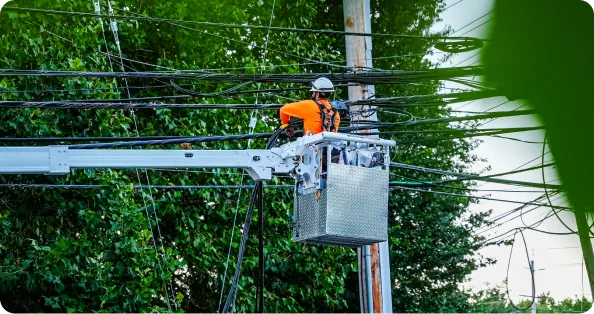

Overhead fiber installation is the aerial side of broadband construction — the crews that hang fiber on existing poles and strand rather than burying it. Where an underground operation lives in the trench and the bore, an aerial operation lives in the air: lashing cable to a messenger strand, attaching to poles already crowded with power and phone, and doing all of it from a bucket truck parked over a road. It is fast, visible work, and the risk concentrates in one place above everything else — the fact that your crew is working at height.
That single fact reshapes the whole insurance profile. The signature exposure of aerial fiber work is the height, and the three injury categories that flow from it are the ones carriers watch most: a fall from a pole or a bucket, a struck-by event where a tool or a span drops onto the public below, and overhead-electrical contact on a pole shared with energized lines. None of those look anything like the bore-strike-and-pollution profile of underground work or the precision-and-E&O profile of a splice crew. An aerial contractor needs coverage built for the danger zone its crews actually occupy.
This page covers how overhead fiber installation insurance is built as an operating model — what makes aerial work distinct, the OSHA and pole-attachment rules that govern it, the full coverage stack and the lines that carry the most weight, the drivers behind cost, how carriers underwrite an aerial crew, and the claims patterns that define the class. If your crews bore fiber underground, the Directional Drilling Insurance page is built for that model; if they run precision fusion splicing, the Fiber Splicing Insurance page covers that one.
Hanging fiber on poles and strand? Get a quote structured around your aerial crew, bucket trucks, and the work at height.
Get a Free QuoteWhat makes overhead fiber installation insurance different
Aerial risk is height risk, and it lands hardest on a different set of coverage lines than underground work does. Workers compensation carries the most severe exposure on the page, because a fall or an electrical contact is a serious injury to your own crew — and on a traveling aerial operation it has to follow them across state lines. General liability is dominated by the struck-by and traffic-zone hazard: aerial work puts the public directly beneath the job, so a dropped tool or a fallen span is a third-party exposure in a way trenching rarely is. Commercial auto carries real weight because the bucket truck is both the work platform and a heavy vehicle on the road. A generic contractor form treats none of these with the emphasis an aerial fiber crew needs.
The other thing that sets aerial work apart is that your crew almost never works on its own poles. Hanging fiber means attaching to infrastructure owned by a power utility or a phone company, under a pole-attachment agreement, often after make-ready work has rearranged the existing attachments to make room for your cable. That puts your crew in contact with other parties’ facilities — and frequently within reach of energized lines — which is why the pole-attachment relationship and the rules around working near power are central to how an aerial operation is underwritten.
State and regulatory considerations
Aerial fiber work sits at the intersection of worker-safety rules, pole-attachment regulation, and the broadband-funding programs driving the buildout. Fall protection, qualified-worker requirements, and the minimum-approach distances around energized lines run through OSHA fall-protection and electrical-safety standards — the federal floor that governs how a crew works at height near power. The right to attach to utility-owned poles, and the terms of doing so, run through FCC pole-attachment rules, which shape the agreements and make-ready obligations your crew works under. And much of the work itself flows from the federal broadband buildout administered through NTIA’s BEAD program and the state broadband offices that distribute it.
On top of the federal layer, contractor licensing and workers compensation are state-by-state matters — electrical and low-voltage licensing varies, and the four monopolistic states write workers compensation only through the state fund, which a traveling crew has to arrange before it mobilizes. As our state pages come online we link the licensing and program specifics for the states that anchor the most aerial fiber activity, including Texas, Virginia, North Carolina, Georgia, and Pennsylvania, across all 48 states we serve.
Coverage breakdown
Here is the stack an aerial fiber operation carries, weighted for work at height. Each line links to its full page, and the three signature lines — the ones the height exposure leans on hardest — lead.
- Workers compensation — the signature line for aerial work: fall, struck-by, and electrical-contact injuries to your own crew, structured to follow a traveling operation across state lines and through the monopolistic-fund states.
- General liability — the third-party exposure of work over roads and property: a dropped tool, a fallen span, or a traffic-zone incident below your bucket.
- Commercial auto — the bucket trucks that are both your work platform and a heavy vehicle on the road, driven across states to follow the build.
- Contractors equipment — the boom and aerial-lift gear, reels, cable handlers, and tools your crew runs at height, insured as inland marine separate from the truck that carries them.
- Umbrella liability — the excess limits the high severity of an aerial loss, and the prime and pole-owner contracts, frequently demand above your primary layer.
- Commercial property — the shop, yard, and the reels and materials staged before they go up on the strand.
What overhead fiber installation insurance costs
Premium tracks the work, not a sticker price. The drivers that move it most for an aerial operation are your payroll and the crew classifications it covers — aerial work rates differently than ground work — the height and electrical-exposure profile of your jobs, the number and value of your bucket trucks and aerial-lift equipment, how much make-ready and energized-pole work you take on, the limits your primes and pole owners require, the states your crews travel to, and your claims history. An operation running heavy aerial spans on shared power poles looks very different to an underwriter than one doing light strand work on dedicated communications poles. We price to that real picture and stand behind any figure we give — verified ranges come from us directly, never a generic guess.
Claims scenarios
These are plausible aerial-contractor claim categories, described qualitatively and with generic carrier language — every claim is handled by the carrier, never named here.
- A fall from a pole or bucket. A crew member is injured working at height — the signature workers compensation exposure of aerial fiber work, and often the most severe.
- Overhead-electrical contact. A crew member or a piece of equipment contacts an energized line on a shared pole — a serious injury exposure that runs through workers compensation and, where a third party is harmed, general liability.
- A struck-by event below the bucket. A dropped tool or a fallen span injures a member of the public or damages property in the traffic zone beneath the job — a third-party general liability claim aerial work is uniquely exposed to.
- A bucket-truck collision in transit. A bucket truck causes or sustains an accident on the way to or from the pole route — a commercial auto loss, with the mounted lift gear handled under contractors equipment.
- Damage to a pole owner’s facilities. Make-ready or attachment work damages the power or phone facilities already on the pole — a third-party property exposure tied to the pole-attachment relationship.
Underwriting realities
Carriers writing the aerial fiber class look hard at how your crew works at height. Fall-protection programs, qualified-worker training for energized-pole work, and a clean record on struck-by and electrical exposures open more markets; a serious fall or electrical-contact loss narrows them. They look at your bucket-truck fleet and how far it travels, your make-ready and energized-pole work mix, your subcontractor controls, and your loss history. Aerial operations that also run an underground or splice division get those portions underwritten separately, because the risk profiles are genuinely different. We position your aerial operation to the carriers most likely to want a crew that works at height, rather than sending one generic submission everywhere and hoping a non-specialist desk understands the exposure.
Why Fiber Optic Guard Insurance
We write one trade, and we understand an aerial fiber job from the bucket up. We weight your stack toward the workers compensation, general liability, and auto exposures that working at height actually carries, structure workers compensation to follow a crew that travels across state lines and through the monopolistic-fund states, build the auto and equipment schedules together so the bucket truck and the lift gear never fall between two policies, and set the pole-attachment certificate and additional-insured requirements that keep a pole owner’s or a prime’s requirement from stalling your start. We place coverage with carriers that want the aerial fiber class. Start with a quote, or send us a pole-attachment agreement or a prime contract and we will tell you what limits it requires.
Learn more
Aerial fiber is one of three distinct fiber operating models. If your crews bore fiber underground, the Directional Drilling Insurance page covers the utility-strike and pollution profile of that work; if they run precision fusion splicing, the Fiber Splicing Insurance page covers the professional-liability profile of that one. The fiber contractor insurance overview explains how the three differ. Every coverage line in the aerial stack has its own page, linked throughout above, and you can see where we write or start a quote.
Coverage for aerial fiber operations
- Workers Compensation Insurance
- General Liability Insurance
- Commercial Auto Insurance
- Contractors Equipment Insurance
- Umbrella Liability Insurance
- Commercial Property Insurance
Primary sources
Frequently asked questions about Overhead Fiber Installation Insurance
What insurance does an aerial fiber installation crew need?
An overhead fiber operation typically carries general liability, commercial auto, workers compensation, contractors equipment, and an umbrella as its core stack. The weight sits differently than an underground crew: the signature exposure is working at height, so workers compensation carries the fall and struck-by injury risk, general liability carries the third-party hazard of work over roads and property, and commercial auto carries the bucket trucks that get the crew to the pole. We build the stack around how your crew runs an aerial job rather than rating it off a generic contractor form.
Why is overhead fiber work treated as a high-hazard exposure?
Because the crew works at height, over traffic, on poles that are frequently shared with energized power lines. A fall from a pole or a bucket, a struck-by event over a roadway, and overhead-electrical contact are the three injury categories that define aerial work, and carriers underwrite them seriously. That is why fall protection, qualified-worker rules, and the minimum-approach distances around energized lines run through OSHA standards, and why a carrier that writes the aerial fiber class looks closely at how your crew is trained and equipped before it quotes.
Does my general liability cover a struck-by claim from aerial work?
Third-party bodily injury and property damage from your work — a dropped tool, a fallen span, or an incident in a traffic-control zone below your bucket — is what general liability is built to answer for. What it does not cover is an injury to your own crew, which is workers compensation, or the bucket truck itself, which is commercial auto. Aerial work puts the public directly beneath the job, so the struck-by and traffic-zone exposures sit at the center of an aerial contractor’s general liability file. We read the policy against the way your crew actually works over roads and property.
My crews work on poles owned by the power and phone companies — does that change my coverage?
It changes the contract requirements and the attachment exposure, not the core stack. Hanging fiber on someone else’s pole runs through a pole-attachment agreement, and the pole owner — along with your prime and any broadband subgrantee — commonly requires a certificate of insurance and additional-insured status before you mobilize. Make-ready work, the rearranging of existing attachments to create space for your cable, adds its own exposure to the facilities already on the pole. We set the certificate and additional-insured language to match what the pole owner and your prime contract demand so a requirement does not stall your start.
Does my workers compensation follow an aerial crew that travels to another state?
It has to be built for it, and this is one of the details that catches traveling fiber contractors. A crew that lives in one state and follows the work into others raises extraterritorial and reciprocity questions, and the four monopolistic states — where workers compensation comes only from the state fund — can interrupt coverage mid-project if it is not arranged ahead of time. Because aerial work carries real fall and electrical injury severity, a workers compensation gap on a traveling crew is among the most serious. We structure the policy for where your crew actually works, not just where it is based.
Is the bucket truck and the boom gear covered under one policy?
No — and the seam is worth being precise about. Commercial auto covers the bucket truck as a vehicle: the chassis, its operation, and the liability and physical damage of driving it. The boom and aerial-lift gear, the reels and cable handlers, and the tools your crew runs at height are insured under contractors equipment, which is inland marine. If a bucket truck rolls, auto responds to the truck and inland marine responds to the mounted gear. We build the auto schedule and the equipment schedule together so nothing on your aerial rig falls between the two policies.
Why do primes and BEAD subgrantees ask for high limits on aerial work?
Because the severity of an aerial loss — a fall, an electrical contact, a struck-by over a roadway — can run high, and the parties whose project you work on want limits that reflect it. Prime contractors, pole owners, and broadband subgrantees frequently require liability limits above what a primary policy carries, often reached through an umbrella. When a prime contract or a BEAD scope specifies limits you do not currently meet, an umbrella is usually the efficient answer, and we size it to the requirement rather than guessing at it.
Insure your aerial fiber work the way your crew runs it
Tell us about your crew, your bucket trucks, and the poles and strand you work, and we will market it to carriers that write the aerial fiber class.