Insurance by operating model
Fiber Splicing Insurance for Fusion-Splice Crews
Coverage for precision fiber splicing operations — where the defining risk is not heavy equipment but splice quality itself, and the signature exposure is professional liability (E&O) for a bad splice or a spec error, alongside the high-value fusion splicers and OTDRs your crew carries.
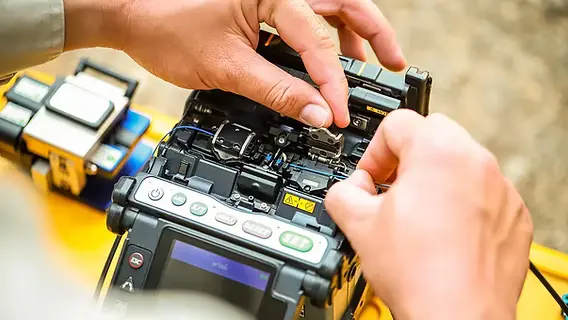

A fiber splicing company sells precision, not earthmoving. The work is the joining of fiber — fusion splices fused fiber-to-fiber, terminated, closed into a case, and then tested to prove the run performs to spec. There is no directional drill traveling blind under a street and no bucket truck working at height near energized lines. The crew, the fusion splicer, the OTDR, and the test set move from access point to access point and make the optical connections that decide whether the build lights. That makes a splice operation look almost nothing like the other two fiber operating models on an underwriter’s desk.
Here is the part that surprises contractors who assume light physical work means light risk: on a splice crew the defining exposure is not heavy equipment or height at all — it is splice quality itself. A fusion splice that does not test out to the loss budget, a build that does not perform to the spec you were handed, an as-built that does not match what is actually in the ground — each of those can cost a prime real money with nothing physically damaged to point to. That is a professional liability (errors and omissions) exposure, and it is the signature risk of splice work. The lighter the equipment and injury exposure, the more your real risk concentrates in the accuracy and quality of the professional work — which is exactly what E&O is built to answer.
This page covers how fiber splicing insurance is built around that reality — what makes splice coverage different, the state and regulatory picture for traveling crews, the coverage lines that matter most and why professional liability leads them, the cost drivers, how a splice claim actually unfolds, and how carriers underwrite a splice operation. If your crews bore underground instead, the Directional Drilling Insurance page is built for that model; if they hang strand and cable at height, see Overhead Fiber Installation Insurance.
Running a splice crew? Get a quote structured around splice quality, your fusion splicers, and the specs your prime contracts impose.
Get a Free QuoteWhat makes fiber splicing insurance different
Splice risk is precision risk, and it lands on different coverage lines than the heavy-physical models do. Professional liability carries the most weight, because the exposure that defines the work — a splice that does not meet spec, an as-built error, a documentation mistake that costs the client money — is professional and financial, not physical. Contractors equipment carries real weight too, because the fusion splicer, the OTDR, and the test set are high-value, portable, and easy to lose to theft from a vehicle or a splice trailer. General liability still matters for the third-party exposures of any job site, but the open-trench and right-of-way profile that dominates a drilling operation is lighter here. A generic contractor form, rated to physical exposure and heavy equipment, gets the weighting backwards for a splice crew and leaves the signature professional-liability seam sitting open.
The point is the weighting. A splice operation needs the physical lines for the ordinary risks of being on a job site, but it needs them sized to a precision trade — and it needs the professional-liability line written front and center rather than treated as an afterthought. That is the difference between a policy built for splice work and one bought off the shelf.
State and regulatory considerations
Splice crews travel, and the regulatory picture follows the work rather than a single home base. Fiber contractor licensing is a patchwork — electrical and low-voltage, utility, or telecom registration depending on the state, and in some places none at all — so a crew that lives in one state and splices in another has to read the requirements where the job is, not where the shop sits. Acceptance-testing, as-built, and spec-compliance obligations increasingly flow down from the federal broadband program through primes and broadband subgrantees, which is where the professional-liability requirement on a splice contract usually originates. The NTIA BroadbandUSA (BEAD) program sets the federal funding framework those contracts run on, the FCC governs the communications infrastructure the work serves, and worker-safety rules on any job site run through OSHA. Workers compensation deserves particular attention for traveling crews — including the four monopolistic states where coverage comes only from the state fund. As state pages come online we link the licensing and program specifics for the markets where splice work is busiest, including Texas, Virginia, Pennsylvania, North Carolina, and California, across our 48 licensed states.
Coverage breakdown
Here is the stack a splice operation carries, weighted for a precision trade rather than a heavy-equipment one. The signature lines lead; each links to its full page.
- Professional liability (E&O) — the signature line: financial loss from a faulty splice, a spec deviation, or an as-built error, where nothing physical was damaged and general liability does not respond.
- Contractors equipment — the other signature line: the fusion splicer, OTDR, and test set in transit and at unattended sites, where theft and damage to high-value portable gear are the exposure.
- General liability — third-party bodily injury and property damage at the job site, lighter than a drilling crew’s open-trench profile but still required by primes.
- Commercial auto — the trucks and splice trailers that carry your crew and gear between access points and across state lines.
- Workers compensation — injury coverage for your crew, with honest handling of the multi-state-payroll reality and the monopolistic state funds.
- Umbrella liability — excess limits the larger prime contracts and broadband subgrantees often demand above your primary layers.
The two that define the trade are professional liability and equipment. The professional-liability page explains the E&O mechanism in full — how a financial loss with no physical damage falls outside general liability and into E&O — so rather than restate it here, we point you to it and concentrate on building the whole splice stack around it.
What fiber splicing insurance costs
Premium tracks the work, not a sticker price. The drivers that move it most are your payroll and crew classifications, your mix of splice, test, and spec-driven work, the value of the fusion splicers and OTDRs you own and where they are stored, whether your scope of work carries acceptance-testing and as-built obligations, the professional-liability and general-liability limits your prime contracts require, the states your crew travels into, and your claims history. A splice operation that certifies performance and produces as-builts the prime relies on looks different to an underwriter than one doing plain terminations under someone else’s spec. We price to that real picture and stand behind any figure we give — verified ranges come from us directly, never a generic guess.
Claims scenarios
These are plausible splice-operation claim categories, described qualitatively and with generic carrier language — every claim is handled by the carrier, never named here.
- Failed acceptance testing on a splice. A fusion splice does not test out to the loss budget or the spec, forcing a re-splice, a re-test, and a schedule slip the prime passes back as a financial loss — the signature professional-liability exposure of splice work.
- As-built or documentation error. Records that do not match what was placed cause a downstream financial loss when the next crew, the locate, or the maintenance team relies on them — a professional-liability question, not a physical-damage one.
- Fusion splicer or test set stolen. A high-value splicer or OTDR is taken from a vehicle or a splice trailer at an unattended site — a contractors equipment loss.
- Third-party injury or property damage at the job site. Someone is hurt around the work, or property is damaged at an access point — the general-liability exposure that any job site carries.
Underwriting realities
Carriers writing the fiber-splice class look at the shape of the professional work as much as the physical exposure. They want to know whether your scope of work involves spec compliance, acceptance testing, and as-built certification — because that is where the professional-liability exposure lives — along with your crew classifications, your equipment list and where it is stored, the states you travel into, and your loss history. A clean acceptance-testing record, disciplined as-built documentation, and clear spec-compliance practices open more markets; a professional-error claim or sloppy documentation narrows them. A contractor who also bores or hangs aerial gets that portion underwritten separately, on its own risk profile. We position your splice operation to the carriers most likely to want a precision trade rather than sending one generic submission everywhere.
Why Fiber Optic Guard Insurance
We write one trade — commercial fiber optic contractors — and we understand a splice operation as a precision trade rather than a generic contractor. We weight your stack toward the professional-liability and equipment exposures that actually define splice work, read the E&O wording — the financial-loss trigger, the defense, the retroactive date — with the underwriter before a policy binds, schedule the fusion splicers and OTDRs that walk off unattended sites, and structure general liability and professional liability as one program so a financial-loss claim cannot fall into the seam between them. When a prime contract lands on your desk asking for E&O limits you do not recognize, that is a call we take. Start with a quote, or send us a contract and we will tell you what limits it requires.
Learn more
Fiber splicing is one of three distinct operating models we write. If your crews bore underground, the Directional Drilling Insurance page covers the utility-strike, frac-out, and pollution profile of that work; if they hang strand and cable at height, Overhead Fiber Installation Insurance covers the height and bucket-truck exposures — and the fiber contractor insurance overview explains how the three differ. The signature splice exposure is explained in depth on the professional liability (E&O) page, and where your crew travels shapes the program through our state pages.
Coverage for fiber splicing operations
- Professional Liability Insurance
- Contractors Equipment Insurance
- General Liability Insurance
- Commercial Auto Insurance
- Workers Compensation Insurance
- Umbrella Liability Insurance
Fiber specialties
Primary sources
Frequently asked questions about Fiber Splicing Insurance
What insurance does a fiber splicing company need?
A splicing operation usually carries professional liability, general liability, contractors equipment, commercial auto, workers compensation, and an umbrella as its core stack — but the weight sits differently than on a drilling or aerial crew. The defining risk of splice work is the quality of the splice itself, which makes professional liability (E&O) the signature line, and the high value of your fusion splicers and OTDRs makes equipment coverage matter more than the lighter physical exposure suggests. We build the stack around precision work rather than heavy equipment or height.
Why does a splice crew need professional liability when the work seems low-risk?
Because the real exposure is professional, not physical. A splice crew is not running a directional drill that can strike a gas line or working from a bucket at height — so the lighter the equipment and injury exposure, the more the actual risk concentrates in the work product: whether the splice tests out, whether the documentation is right, whether the system performs to the spec you were handed. A faulty splice or an as-built error can cost a prime real money with nothing physically damaged, and that financial loss is exactly what professional liability is built to answer. Our professional liability page explains the mechanism in full.
Does general liability cover a bad splice?
Not when the only harm is financial. General liability responds to third-party bodily injury and property damage — someone hurt around your work, or property damaged at the job site. A splice that fails acceptance testing and forces a re-splice, a re-test, and a schedule slip injures no one and breaks nothing physical, so it sits outside the general liability form. That purely economic loss is professional liability (E&O) territory, which is why a splice-heavy operation carries both lines. We read the seam rather than letting you assume one policy answers everything.
Is my fusion splicer covered if it is stolen from a job site?
That is one of the main reasons splice crews carry contractors equipment coverage. A fusion splicer, an OTDR, and the rest of the test set are high-value, portable, and frequently left in a vehicle or a splice trailer at an unattended or remote site — a known theft and damage target. Contractors equipment (inland marine) is built to respond to theft and damage where the gear sits unattended and while it is in transit, subject to the policy terms. We confirm how the form treats your fusion splicer and test gear before you bind.
Do primes and BEAD subgrantees require E&O from splice contractors?
Increasingly, yes. As acceptance testing, as-built accuracy, and spec compliance have become contract conditions on broadband builds, more primes and broadband subgrantees ask their splice subcontractors to carry professional liability alongside general liability and the rest of the program. The exact requirement varies by contract. We help you read what a prime contract actually demands and structure E&O to satisfy it, so a missing line does not cost you a bid or hold up a certificate.
How is fiber splicing insurance priced?
Premium tracks the work, not a sticker price. The drivers that move it most are your payroll and crew classifications, the mix of splice, test, and spec-driven work you do, the value of the fusion splicers and OTDRs you own and where they are stored, whether your scope of work carries as-built and acceptance-testing obligations, the limits your prime contracts require, the states your crew travels into, and your claims history. We price to that real picture and stand behind any figure we give — verified ranges come from us directly, never a generic guess.
Does workers compensation follow my splice crew across state lines?
It has to be built to. Many splice crews live in one state and follow the work into others, and workers compensation is the line that most often catches a traveling contractor — extraterritorial provisions, reciprocity, and the four monopolistic states where coverage comes only from the state fund all bear on whether your crew is covered where it actually works. We structure the multi-state payroll reality up front rather than discovering a gap mid-project.
How is fiber splicing insurance different from drilling or aerial coverage?
The risk shape is different. Directional drilling carries a utility-strike, frac-out, and pollution profile, and aerial installation carries a height, bucket-truck, and overhead-electrical profile — both are heavy-physical-exposure models. Splicing carries comparatively little of that and concentrates its real exposure in the precision of the work: the splice quality, the spec compliance, and the as-builts. That is why the splice stack leans toward professional liability and equipment rather than the pollution and height lines that define the other two pillars.
Insure your splice crew for the way it actually works
Tell us about your splice and spec work, your fusion splicers, and your prime contracts, and we will market it to carriers that write the class.