
Insurance by operating model
Directional Drilling Insurance for Fiber Optic Contractors
Insurance for horizontal directional drilling (HDD) crews installing fiber underground — the bore, utility-strike, frac-out, pollution, and drill-rig exposures that define the way an HDD operation actually runs.
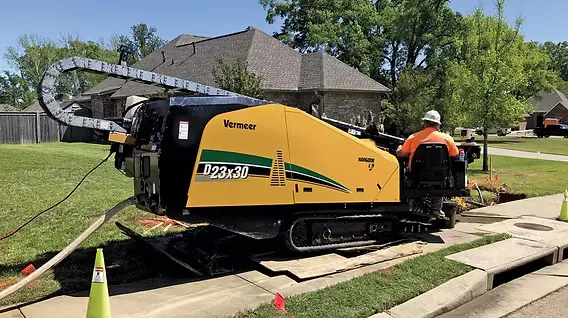

Directional drilling is its own operating model, not a coverage line — and the way an HDD crew works is what makes its insurance distinct. A horizontal directional drilling operation installs fiber underground without an open trench: it sets a drill rig at an entry pit, steers a bore beneath roads, yards, waterways, and live utility corridors, and pulls fiber conduit back through the hole. The whole method depends on threading a bore blind through ground the crew does not own, pushing pressurized drilling fluid the entire way. That is a very different risk picture from an aerial crew working off a bucket or a splice team on a fusion machine — and it demands a program built around the bore.
Two exposures define the model and concentrate the risk. The first is the utility strike — the bore or the back-reaming pull hits a buried gas, sewer, fuel, or fiber line that the locate did not fully account for, and what the line was carrying releases into the ground. The second is the frac-out, the inadvertent return of pressurized drilling fluid to the surface where it should not be — a lawn, a roadway, a wetland, or a stream. Both carry an environmental loss, and that environmental loss is the signature directional-drilling exposure: it is the one most likely to be uninsured, because the policy a contractor assumes will respond — general liability — is the one form written to exclude pollution. That gap is why pollution liability is the signature coverage for an HDD operation.
On top of the bore itself, the model carries the realities of running heavy mobile equipment that follows the work. A six-figure directional drill, a locator, and the support gear sit at remote, often unattended bore sites and travel between jobs and across state lines. The crew that runs them frequently lives in one state and bores in another. And the larger broadband jobs — prime contracts, ISP work, and BEAD subgrantee scopes — attach insurance, limit, and additional-insured requirements an underground operation has to meet to win the work.
This page covers how directional drilling insurance is built as a whole: what HDD work is and the phases a bore runs through, the bore-strike and frac-out risk profile, the full coverage stack the operating model needs, the drivers that move cost, and how carriers underwrite an HDD operation. If your work is aerial or splice-led instead, the Overhead Fiber Installation Insurance and Fiber Splicing Insurance pages are built for those models.
Running directional bores? Get a quote structured around your bore profile, drill rig, and the pollution exposure HDD work carries.
Get a Free QuoteWhat makes directional drilling insurance different
Directional drilling risk is bore risk, and it lands hardest on a few coverage lines in a way a generic contractor form does not anticipate. Pollution liability carries the most weight, because the utility strike and the frac-out are environmental losses the standard general liability form excludes — the signature seam of underground work. General liability still answers for the third-party injury and the non-pollution property damage along the route, but it hands the environmental piece off. Contractors equipment matters more than on most trades because the drill rig is a high-value machine that lives at remote, unattended sites and on the road. And umbrella liability becomes a contract requirement on larger broadband jobs. A policy rated to "general contractor" treats none of these with the emphasis an HDD operation needs.
The practical consequence is that two fiber contractors with similar revenue can carry very different exposures depending on how much of the scope is boring. A crew that bores past live utilities and pushes fluid under streams looks nothing like a crew that hangs strand or runs a fusion splicer — and writing both off one form underprices the bore and strands the pollution exposure. We separate the directional drilling scope from any aerial or splice work in the same book so neither is mispriced.
The phases of a directional drilling job
An HDD bore is a sequence, and the exposure shifts as the work moves through it. The crew sets the drill rig and an entry pit, then steers the pilot bore beneath the obstacle — a road, a yard, a utility corridor, or a waterway — following a locate and a bore plan. Once the pilot hole is through, back-reaming widens it while pulling the fiber conduit back toward the entry, with drilling fluid circulating the whole time to stabilize the hole and carry cuttings. The signature events live in the middle of that sequence: a utility strike when the bore or the pull contacts a buried line the locate missed, and a frac-out when pressurized fluid finds a fracture and surfaces away from the rig. The diagram below maps the operating model — entry pit, the bore beneath an obstacle and its utilities, and the exit — with the strike, frac-out, locate, and drill-rig risks marked along the path.
State and regulatory considerations
Directional drilling sits at the intersection of underground damage prevention, environmental rules, and worker safety — and the rules vary by state. Before any bore, contacting your state 811 one-call center to mark buried utilities is the national damage-prevention standard, and a clean locate history is something underwriters and primes both look for. The environmental side runs through the U.S. EPA framework when a frac-out or strike reaches a waterway, while excavation, pit, and trench safety on the job site run through OSHA construction standards. Contractor licensing for underground utility and low-voltage work is a state-by-state patchwork, and workers compensation rules vary too — including the four monopolistic states where coverage comes only from the state fund, which matters for a crew that bores across state lines.
Much of the directional drilling work is driven by federal broadband funding through the NTIA BEAD program, administered state by state through the broadband offices — and BEAD and prime contracts are where most of the insurance and limit requirements originate. As our state pages come online we link the licensing, permitting, and damage-prevention specifics for the states we serve. Tier-1 directional drilling activity is concentrated in states such as Texas, Virginia, Pennsylvania, North Carolina, and Indiana, and we write across all 48 licensed states.
Where a state page exists, it works that state’s actual law rather than repeating the national picture — and the answers diverge more than most contractors expect. One state voids the certificate requirement outright; the state next to it expressly permits the same promise.
The statute reaches your insurance, not just your promise
Here the endorsement is inside the rule. Moving a transfer out of the indemnity paragraph and into the certificate does not save it.
- Texas — it voids the additional-insured requirement by name
- California — §2782.05, and the parties cannot waive it
- Colorado — indemnify, insure or defend — all three
- Oregon — it names your insurer, and names tunneling
- Utah — insuring sits inside a provision void outright
- Minnesota — and separately, a certificate waives nothing
- Kansas — the endorsement is void by name, not by inference
- Oklahoma — your insurer is named, and so is the forum
- Montana — insure sits in the voided verb list
- Louisiana — procuring cover for a prime is null here
The statute stops at the promise — your certificate survives it
The indemnity clause is cut back and the insurance requirement beside it is left standing, so risk transfer relocates rather than disappearing.
- Illinois — 35/3 removes insurance from the Act entirely
- Missouri — the promise is expressly permitted by statute
- Ohio — Buckeye Union settled it for endorsements
- Virginia — preserved, but only for an admitted insurer
- Massachusetts — the test is simply what you caused
- Indiana — sole negligence only; a court can treble
- Wisconsin — the broadest text, the narrowest reach
- West Virginia — insurance is excluded, and the board can lien
- Nebraska — own negligence voided, the certificate untouched
- Delaware — void even when the drafting is flawless
- Rhode Island — bonds and own-protection cover expressly saved
- Kentucky — void outright, but bonds and cover untouched
- New Jersey — it reaches a purchase order, not just a contract
Whether the statute applies at all is the first question
Before the clause is worth reading, something else has to be established — who owns the project, whose land the route crosses, or how the bargain was struck.
- Florida — held not to reach utility-line work
- Arizona — private contracts only; public work is out
- Michigan — the answer changes with who owns it
- Washington — only if the waiver was mutually negotiated
- Iowa — it stops at the public street agreement
- South Carolina — co-ops and rail are excluded outright
- Idaho — a short list, no road, no catch-all
- South Dakota — four items only; even highway is absent
- Wyoming — written for wells and mine shafts
- Pennsylvania — designers and snow plows; a rule fills the rest
- Nevada — residential defect claims, and nothing wider
The statute names your work, and then says nothing about insurance
A scope question these pages usually have to flag is already answered here — the enumerated work reaches an underground utility line in terms. What the section does not do is mention insurance at all, and silence is not a carve-out, so these pages state the reach and decline to read a rule out of the gap.
- New Hampshire — utility line named; insurance not mentioned
Where the damage prevention law does the work instead
A small group of states carry an anti-indemnity statute whose scope no court there has yet applied to utility work. These pages set out the underground rules, which are settled, state whatever the contract statute does decide, and mark the boundary rather than guessing past it.
- North Carolina — a board of fifteen, and two ways liability comes off you
- New York — the Attorney General sues; three hits stop the job
- Maryland — no ticket is deemed negligent before anyone argues
- Connecticut — forty thousand, unless a utility mismarked harmlessly
Where no contract statute was located, and the field rules carry the page
On these pages we searched for an anti-indemnity statute and did not find one, so the page runs a single axis and says so in its own words. That is a statement about a search, never a finding that no such law exists. Two of them are built on administrative rules rather than the code, and each says which.
- Maine — marked or three days, whichever comes first
- Vermont — open the ground before the machine goes near it
- North Dakota — the ticket asks whether you are boring
- Tennessee — a heading that promises what its text declines
- Georgia — fiber is named in the rule itself
- Alabama — inadmissible against you, discoverable anyway
Where no statutory text was reachable, and the page says so
These pages set out the physical risk of a bore and the coverage that answers it, and they stop there. We could not retrieve the current codified text from a first-party publisher, so they cite no statute and make no generalization about what the state requires. Take notice requirements from the state one-call service.
- Arkansas — rock in the west, alluvium in the east
- Mississippi — how far would a release have to travel
- New Mexico — hauled water, hard ground, long distances
Coverage breakdown
Here is the stack a directional drilling operation carries, weighted for the bore-led model. Each line links to its full page — and the two that carry the most weight for HDD work, pollution liability and contractors equipment, are the signature placements.
- Pollution liability — the signature HDD line: the cleanup, third-party environmental damage, and defense for a bore-strike release or a frac-out, the loss general liability excludes. The pollution page covers the mechanism in full.
- Contractors equipment — the drill rig itself, plus locators and support gear, in transit and at remote, unattended bore sites where theft and damage are the concern.
- General liability — third-party injury and the non-pollution property damage along the route and in the public right-of-way, with the environmental piece handed to pollution liability.
- Commercial auto — the trucks and trailers that haul the drill rig and crew between bore sites and across state lines.
- Workers compensation — for the crew at the entry and exit pits, structured for the multi-state payroll reality of a traveling drilling operation.
- Umbrella liability — excess limits the larger broadband jobs, prime contracts, and BEAD scopes demand above the primary layer.
- Commercial property — the shop, yard, and stored reels and materials the operation works from.
What directional drilling insurance costs
Premium tracks the bore, not a sticker price. The drivers that move it most are your payroll and the crew classifications it covers, how much of your scope is directional drilling versus aerial or splice work, the value of the drill rig and gear you own and where it is stored, the sensitivity of the ground and the waterways you bore near, the limit and pollution requirements your prime contracts and BEAD scopes impose, your multi-state footprint, and your claims and locate history. A crew running deep bores past live utilities and under streams looks very different to an underwriter than one doing light, shallow work in open ground. We price to that real picture and stand behind any figure we give — verified ranges come from us directly, never a generic guess.
Claims scenarios
These are plausible directional-drilling claim categories, described qualitatively and with generic carrier language — every claim is handled by the carrier, never named here — and with no fabricated cost or frequency figures.
- Frac-out into a waterway or wetland. Pressurized drilling fluid surfaces into a stream, river, or wetland during a bore — the environmental loss most specific to HDD work, driven by turbidity, habitat impact, and regulatory cleanup demands.
- Utility strike on a buried line. The bore or the back-reaming pull hits a gas, sewer, or fuel line the locate did not account for, producing both a physical strike and an environmental release.
- Drill rig theft from a remote site. A directional drill or locator is taken from an unattended bore site overnight — a high-severity contractors equipment loss.
- Right-of-way and third-party property claim. A bore, an entry or exit pit, or restoration work damages a property owner’s driveway, landscaping, or an adjacent lot along the corridor.
Underwriting realities
Carriers writing the directional drilling class look at the bore profile: payroll and crew classifications, how deep and how often you bore, the ground and waterways you work near, your drill rig and equipment list and where it is stored, your locate and damage-prevention discipline, your subcontractor controls, and your loss history. A clean 811 locate record, documented bore plans, strong subcontract and certificate discipline, and a clean environmental history open more markets; a serious frac-out or utility-strike loss narrows them. Contractors who also run aerial or splice divisions get those portions underwritten separately so the bore is not subsidizing — or stranding — the rest of the book. We position your operation to the carriers most likely to want an HDD risk rather than sending one generic submission everywhere.
Why Fiber Optic Guard Insurance
We write one trade — commercial fiber optic contractors — and within it we treat directional drilling as the bore-led, pollution-exposed operation it is. We weight your stack toward the pollution, equipment, liability, and excess exposures an HDD crew actually carries, read the pollution wording against the way your crew bores rather than assuming it away, schedule the drill rig that sits at remote sites, structure workers compensation for a crew that crosses state lines, and set the subcontractor and additional-insured requirements that keep a boring sub’s frac-out off your policy. We place coverage with carriers that want the directional drilling class. Start with a quote, or send us a prime contract and we will tell you what limits and pollution coverage it requires.
Learn more
Directional drilling is one of three fiber operating models, and the coverage stack shifts with the work. The signature HDD exposure lives on the pollution liability page, and the drill rig itself on contractors equipment. If your work is aerial or splice-led, the Overhead Fiber Installation Insurance and Fiber Splicing Insurance pages are built for those models — and the fiber contractor services overview explains how the three differ.
Coverage for directional drilling operations
- General Liability Insurance
- Commercial Property Insurance
- Contractors Equipment Insurance
- Workers Compensation Insurance
- Commercial Auto Insurance
- Pollution Liability Insurance
- Umbrella Liability Insurance
- Professional Liability Insurance
Fiber specialties
Get covered
Primary sources
Frequently asked questions about Directional Drilling Insurance
What insurance does a directional drilling contractor need?
A horizontal directional drilling operation typically carries general liability, pollution liability, contractors equipment, commercial auto, workers compensation, and an umbrella as its core stack. The weight sits differently than it does for an aerial or splice crew: the underground bore concentrates risk in two places a standard contractor form handles poorly — the utility strike and the frac-out, both of which carry an environmental exposure that general liability excludes. We build the stack around the way your bores actually run rather than rating you off a generic contractor policy.
Why is pollution liability so important for HDD work?
Because the signature loss of directional drilling is environmental, and the policy a contractor assumes will respond is the one form written to exclude it. When a bore strikes a buried gas, sewer, or fuel line, or when a frac-out pushes drilling fluid to the surface, the release that follows is a pollution condition — and the standard general liability form carries an absolute pollution exclusion that drops it. Pollution liability is the separate line that fills exactly that gap. It is the signature coverage for the HDD side of a fiber book, which is why we treat it as central rather than optional. The pollution liability page explains the mechanism in full.
Does calling 811 before a bore mean I am covered if I hit a line?
No. Contacting your state 811 one-call center before you bore is the underground damage-prevention standard, and it is essential — but a locate is not coverage. Marks can be inaccurate, records can be wrong, and abandoned or unmarked lines exist, so a bore can strike a line even on a job where every step was done right. A clean locate history strengthens your file and your defense; it does not remove the exposure or replace the policy. We build the program for the strike that happens despite a clean locate.
Is my directional drill covered if it is stolen from a remote job site?
That is one of the main reasons HDD crews carry contractors equipment coverage. A directional drill, a locator, and the support gear left at a remote or unattended bore site overnight or over a weekend are a known theft and damage target, and the loss on a six-figure rig can be severe. Contractors equipment (inland marine) is built to respond to theft and damage where the gear sits unattended and while it is in transit between job sites and states, subject to the policy terms. We confirm how the form treats unattended-site theft before you bind.
How does workers comp work when my drilling crew travels across state lines?
It is one of the trickier parts of running an HDD operation that follows the work. When a crew lives in one state and bores in another, workers compensation has to account for payroll earned across state lines, extraterritorial and reciprocity rules, and the four monopolistic states where coverage comes only from the state fund. Getting this wrong shows up as a gap mid-project or a surprise at audit. We structure workers compensation for the multi-state payroll reality of a traveling drilling crew rather than a single home base.
Why do BEAD and prime contracts drive my directional drilling limits?
Larger broadband jobs — work for primes, ISPs, and BEAD subgrantees — frequently demand liability limits, additional-insured status, and pollution coverage higher and broader than a primary policy carries on its own. An umbrella is the efficient way to reach the liability limits, and pollution liability with the right limit satisfies the environmental requirement an underground scope triggers. When a contract specifies requirements you do not currently meet, that is usually the conversation, and we size the program to the requirement rather than quote a number.
Do my boring subcontractors need their own insurance?
Yes, and on directional work it matters more than almost anywhere. If you sub out boring, a subcontractor’s frac-out or utility strike happened on your job and under your prime contract, so the loss can roll up onto your general liability and your pollution exposure fast. The standard discipline is written subcontract agreements, certificates of insurance confirming each boring sub carries its own pollution liability, and additional-insured status flowing up to you. We help you set those requirements so a sub’s environmental loss does not become yours.
Insure your directional drilling work the way you bore
Tell us about your bore profile, your drill rig, and the prime contracts you sign, and we will market it to carriers that write the HDD class.