

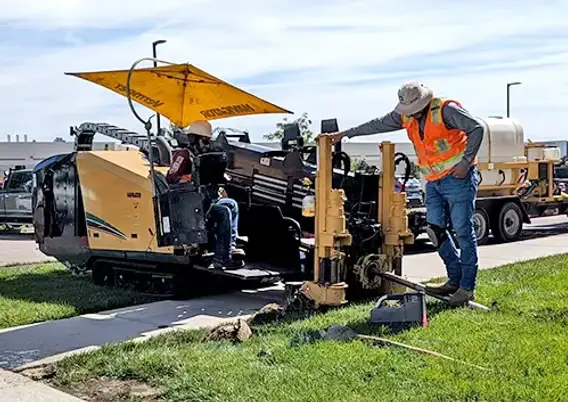
Hiring and keeping fiber crews in a tight labor market is one of the hardest parts of running a directional drilling, aerial, or splicing operation right now — the work is out there, but the skilled hands to do it are scarce, and the contractors who win are the ones who treat staffing as a system rather than a scramble. Before we get into it, one thing to set straight: this is general education, not legal, tax, or financial advice — confirm specifics with your own attorney, CPA, or licensed advisor, especially on the employee-versus-subcontractor question, which is fact-specific and carries real consequences. With that said, the levers a contractor actually controls come down to three: building a real pipeline, retaining the people you already have, and getting your crew structure right so it does not become a payroll, workers-comp, or audit problem later.
Why fiber labor is so tight
The fiber buildout is pulling on a labor pool that was already thin. Directional drilling, aerial line work, and fusion splicing are skilled trades — a good driller reads soil and locates utilities by feel, an aerial tech works at height around energized lines, and a splicer terminates glass to a tolerance most people never see. None of that is learned in a week. When demand for construction surges across many states at once, every contractor is fishing in the same small pond, and the experienced operators get bid up or poached.
That dynamic rewards contractors who stop competing only on wage and start competing on everything around the wage: how steady the work is, how the equipment is kept, how travel is handled, and whether a worker is treated as a craftsperson. Those are the things you control, and they are what the next sections are about.
Building a recruiting pipeline, not a job post
The contractors who staff well rarely rely on a single job listing when a crew comes up short. They run a pipeline that is always moving, so a departure is a planned backfill rather than a crisis. That pipeline has a few common sources.
Trade schools, lineman programs, and registered apprenticeships are the most durable source because they produce people trained to a standard and inclined to stay where they learned. Internal cross-training is the cheapest source you already own — a reliable laborer can be grown into a drill operator or an aerial tech over a season or two, and that person already knows your standards. Referrals from your existing crew tend to bring in people who fit your culture, and they cost little. Experienced hires off the open market are the fastest but the most expensive and the least loyal, because someone who left a competitor for pay will leave you the same way. A contractor who leans only on that last source is always overpaying and always exposed.
Apprenticeships deserve a closer look, because they address the labor shortage at its root rather than just shuffling the same scarce workers between contractors. The market rarely supplies enough finished drillers, aerial techs, and splicers to hire off the street, so the operations that grow their own — through a formal apprenticeship, a partnership with a local program, or a structured helper-to-operator path inside the company — end up with crews trained to their own standards and loyal because of where they learned. It is a longer play than poaching a finished hand, and it asks the contractor to invest in someone before that person is fully productive. But it is the one source of labor that actually expands the pool instead of fighting over it, and in a tight market that is worth a great deal.
Retention is cheaper than recruiting
Every crew member you keep is one you do not have to find, train, and insure from scratch. In skilled trades, retention rests on steadiness as much as money. Crews stay where the work is consistent through the seasons, where the equipment is maintained so they are not fighting broken gear, where travel is organized and paid fairly, and where they are treated as the skilled craftspeople they are rather than interchangeable bodies.
A clear path to advance matters too. A helper who can see the road to operator, and an operator who can see the road to crew lead, has a reason to stay through a slow stretch. So does respect for the difficulty of the work — drillers, aerial techs, and splicers know their trade is hard, and they notice whether the contractor knows it too. None of this is exotic, but it is what separates the operations that hold their people from the ones that bleed them to the next bidder. If you run a traveling operation, how you handle the logistics of life on the road is a retention tool in itself — our guide on managing a traveling fiber crew walks the operations side that keeps people willing to follow the work.
The employee-versus-subcontractor question
This is the part that turns a labor decision into a legal and insurance one, and it is where the disclaimer above matters most. Whether a worker is properly an employee or an independent subcontractor is not something you get to simply declare on paper — it turns on the actual working relationship, and it is a fact-specific determination. The federal frameworks that govern it come from the IRS, which publishes guidance on worker classification at irs.gov, and the U.S. Department of Labor, which addresses it under wage-and-hour rules at dol.gov. Those agencies weigh factors around control, independence, and the economic reality of the relationship.
I am deliberately not going to tell you how any specific worker should be classified or recite a test outcome as if it were settled — that is exactly the kind of fact-specific call you should run past your own attorney or CPA. What I can tell you is why it matters so much to a contractor: getting it wrong is expensive. A worker treated as a subcontractor who functions like an employee can trigger back-payroll exposure, penalties, and a coverage gap if that person is hurt. The cost of confirming the structure with an advisor up front is small against the cost of a misclassification surfacing at audit or after an injury.
How classification flows into your coverage
Classification is not an abstract paperwork question — it flows straight into workers compensation. Your payroll determines your workers compensation coverage and the audit that trues up your premium at the end of the term. Workers you treat as employees belong on that payroll; workers you use as legitimate subcontractors generally need to carry their own coverage and provide you certificates of insurance, because a comp audit can otherwise pick up uninsured subs and charge for them as if they were yours.
That is the practical link between a hiring decision and an insurance outcome. The U.S. Department of Labor also addresses the wage-and-hour side of how workers are treated at dol.gov, which is part of the same picture as classification. A contractor who decides crew structure casually can find the consequences at audit time, when the premium is recalculated against who was actually on the books. Aligning your coverage with how your crews really work — and keeping subcontractor certificates current — is part of running the labor side cleanly. For crews working high-risk specialties, the stakes climb: directional drilling and aerial fiber installation carry exposures that make getting comp and classification right non-negotiable.
Real-World Scenario: A contractor short on splicers brings on two experienced techs as “subs” to hit a deadline, working them on his own schedule, with his equipment, alongside his employees. One is injured on the job. Because the working relationship looked a lot like employment, the question of who covers the injury — and whether those workers belonged on his comp payroll all along — surfaces at the worst possible moment. A contractor who had confirmed the structure with an advisor and kept certificates in hand would have known the answer before the injury, not after.
Tie the labor plan to the season ahead
The contractors who staff best treat hiring, retention, and classification as one connected plan rather than three separate fire drills. They recruit ahead of need, they keep their people with steadiness and respect, and they get the employee-versus-subcontractor structure confirmed before it can bite — knowing it shapes their workers-comp coverage and their audit. If you are building a crew for the wave of work ahead, our piece on where the fiber work is coming from sets the demand picture, and our guides on how fiber contractors find and win jobs and what primes and ISPs require before they hire a crew round out the staffing-to-bidding path.
When you are ready to align coverage with the crew you actually run, start a quote or browse the full coverage overview to see how workers comp fits with the rest of the program.